
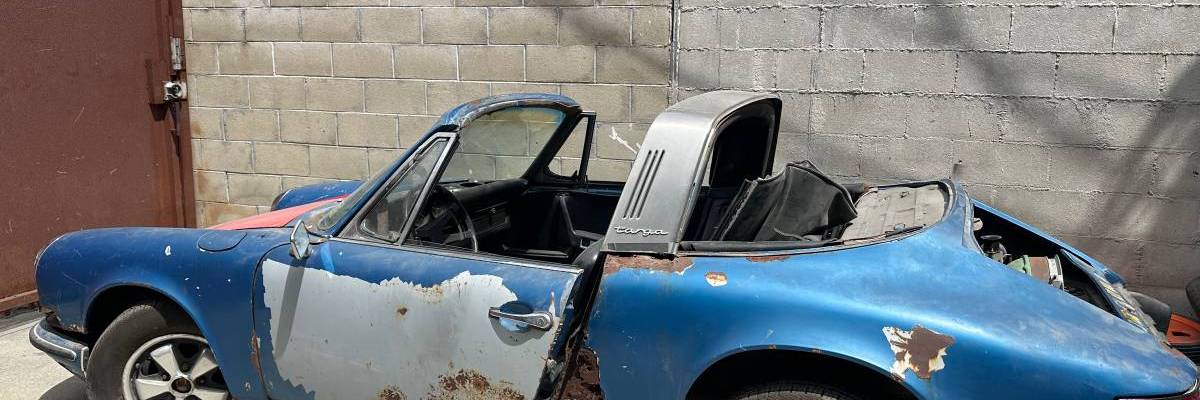
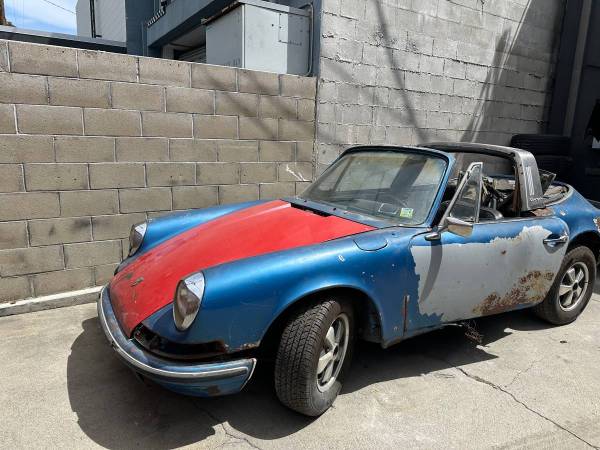
The 1973 911 Targa sits at the end of the early long-hood period, just before the impact-bumper generation changed the shape and character of the model. That gives it an automatic place in the 911 timeline, but cars like this are not interesting simply because of the year. On an early 911 project, what matters is whether the shell, identity and major components still justify the work, because the real line is usually between a recoverable car and an expensive structural problem.
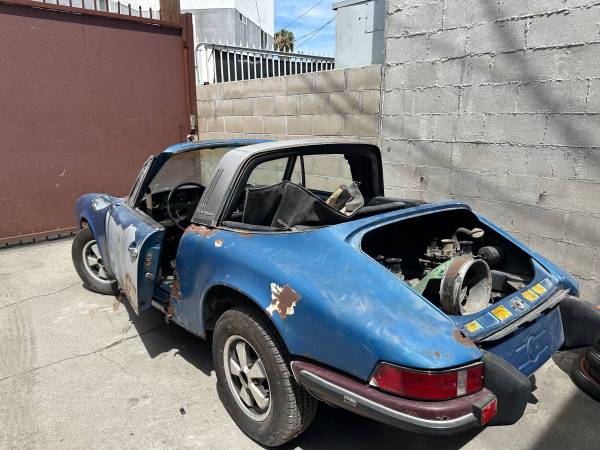
From the photos, this example is clearly a full project. The body shows extensive visible corrosion, especially around the lower door area, rocker section and rear quarter near the Targa bar. The front lid is in red primer, the paint is worn and inconsistent, and the car appears partly dismantled. Inside, the cabin is incomplete and tired rather than preserved, with missing trim and exposed surfaces that suggest a long-stalled restoration or disassembly. At the rear, the engine is present but exposed, with the grille and engine-lid area removed. More importantly, what is visible in the engine bay does not look consistent with a stock 1973 US-spec 911T. The green fan shroud points more toward an E-type visual cue than a T, and the induction layout does not resemble the usual US-market CIS setup. That does not prove the car has an E engine, since shrouds can be changed and engines can be swapped or assembled from mixed components, but it does raise a real question about mechanical correctness.
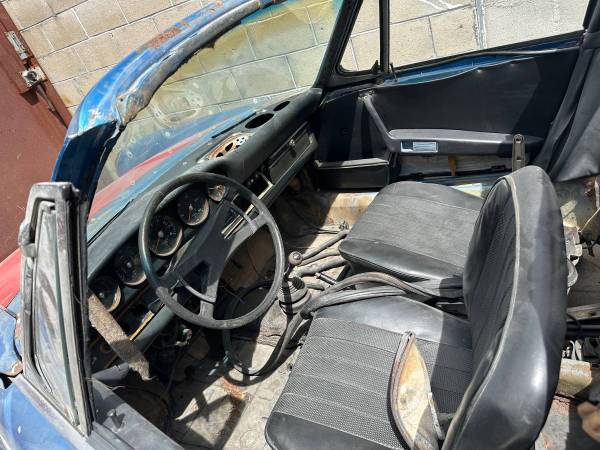
That is what makes the car worth a look, but also what makes it risky. The appeal is not tidy originality, but the possibility that enough of the car is still right to justify saving it. On this example, the key checks would be the shell, floor, longitudinals, suspension pick-up points, and the relationship between VIN, engine and gearbox. Here the engine question matters more than usual, because the photos suggest the car may not retain a straightforward, factory-correct drivetrain configuration. If that proves true, the project becomes less about recommissioning a coherent 1973 Targa and more about sorting out what the car actually is. As shown, it should be approached first as a structural and identity exercise, and only after that as a Porsche restoration. Find it for sale at $12,500 here in Los Angeles, CA, USA.

