

Anyone who bought a Ferrari Daytona in 2005 wasn’t making an investment. They were buying a car. Twenty years later, that same decision gets tracked by financial indices, discussed in global wealth reports and cited as a textbook example of a “passion asset.”
Something changed profoundly — and it is changing again, right now.
Here is the full picture: where we’ve come from, where the market actually stands today once you strip away the headline noise, and which forces will shape the next ten years.
2005-2015: The decade classics became an Asset Class
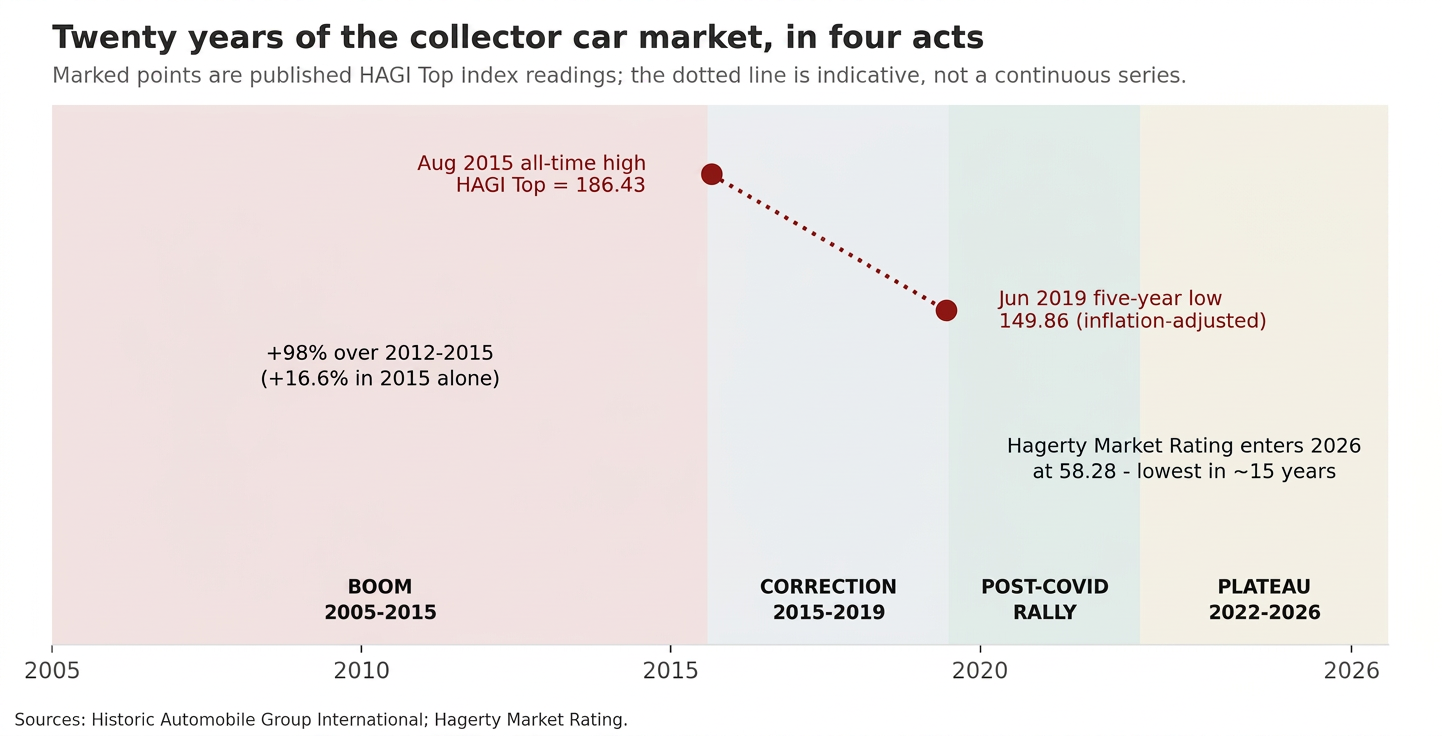
The first half of our twenty-year window built the sector’s reputation. The HAGI Top index, which tracks around fifty blue-chip post-war models, strung together years of double-digit growth: +13.89% in 2011, and a 2012-2015 run worth nearly +98% on its own, capped by +16.57% in 2015.
Three forces drove it, and they’re worth remembering because they help explain the present:
- Zero interest rates. After 2008, money was cheap and bond yields were crushed. Capital went hunting for returns elsewhere: art, watches, wine, cars.
- Genuine scarcity. Thirty-six 250 GTOs exist, and nobody is building more. In a market with rising demand, fixed supply does the rest.
- The showcase effect. The major auction houses turned Monterey, Villa d’Este and Rétromobile into global media events. Every record made news, and every news story pulled in new buyers.
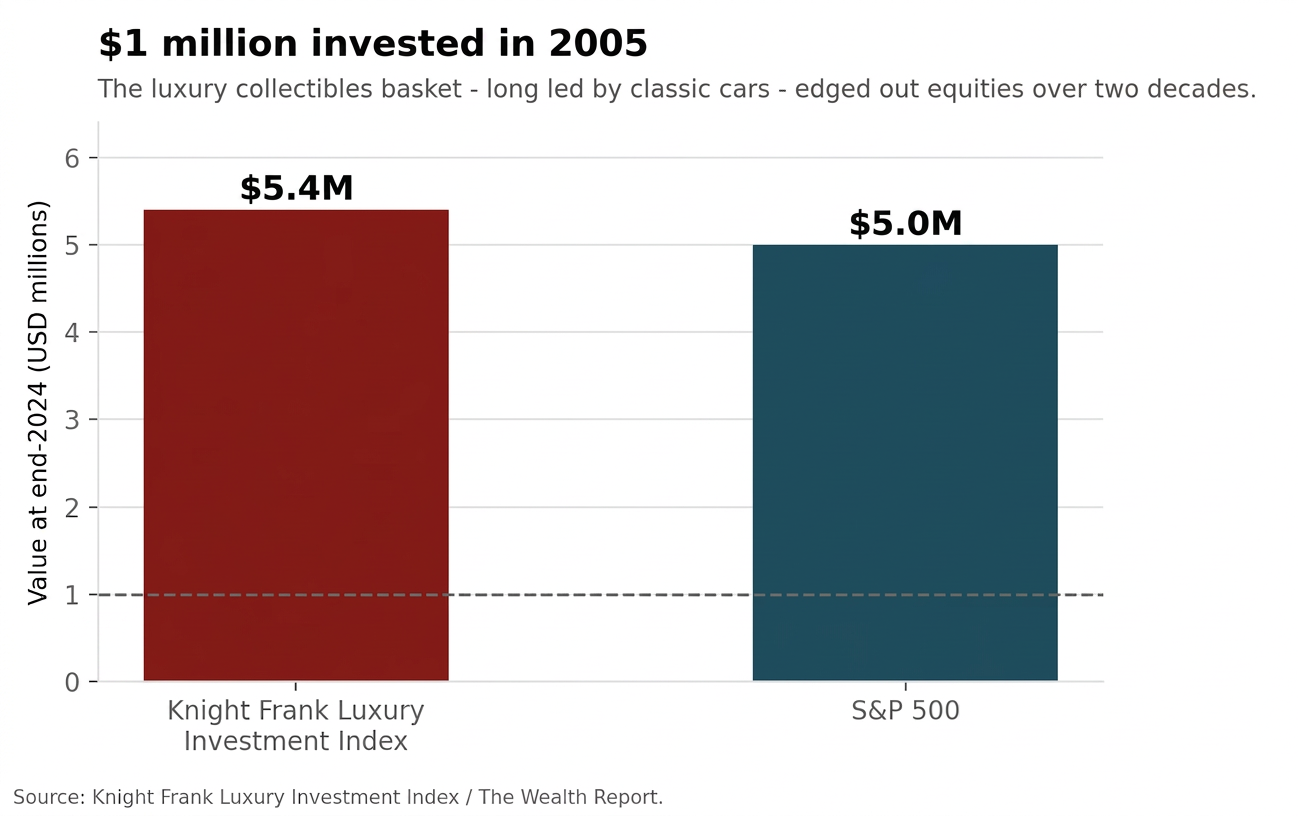
The aggregate result is striking. Someone who put $1 million into the Knight Frank Luxury Investment Index in 2005 would have held $5.4 million by the end of 2024, against $5 million for the same sum in the S&P 500. Cars were the basket’s engine for much of that stretch.
2015-2020: The Hangover
The peak arrives in August 2015, with HAGI Top at 186.43. Then the direction reverses. Adjusted for inflation, the index slides to a five-year low of 149.86 by June 2019 — roughly a 20% real loss in under four years.
It wasn’t a dramatic crash so much as a slow deflation. People who had bought out of passion kept driving. People who had bought to flip in eighteen months were left with a car in the garage.
That is the single most useful lesson of the whole twenty-year period: the classic car market is not liquid. Selling well takes time, the right channel and — above all — a car somebody actually wants.
2020-2022: The rebound nobody saw coming
Covid was supposed to finish the sector off. It did the opposite. Lockdowns, abundant liquidity, rediscovered hobbies and the arrival of online auction platforms produced a violent rally that peaked in the summer of 2022.
This is also when the period’s most important structural change happened: the auction moved online. Bring a Trailer, Collecting Cars and Cars & Bids lowered the barrier to entry, made prices public and searchable by anyone, and brought in a generation of buyers who would never have set foot under the tent at Pebble Beach.
Where we are now: The 2025-2026 Paradox
Pay attention here, because the headlines tell two opposite stories and both are true.
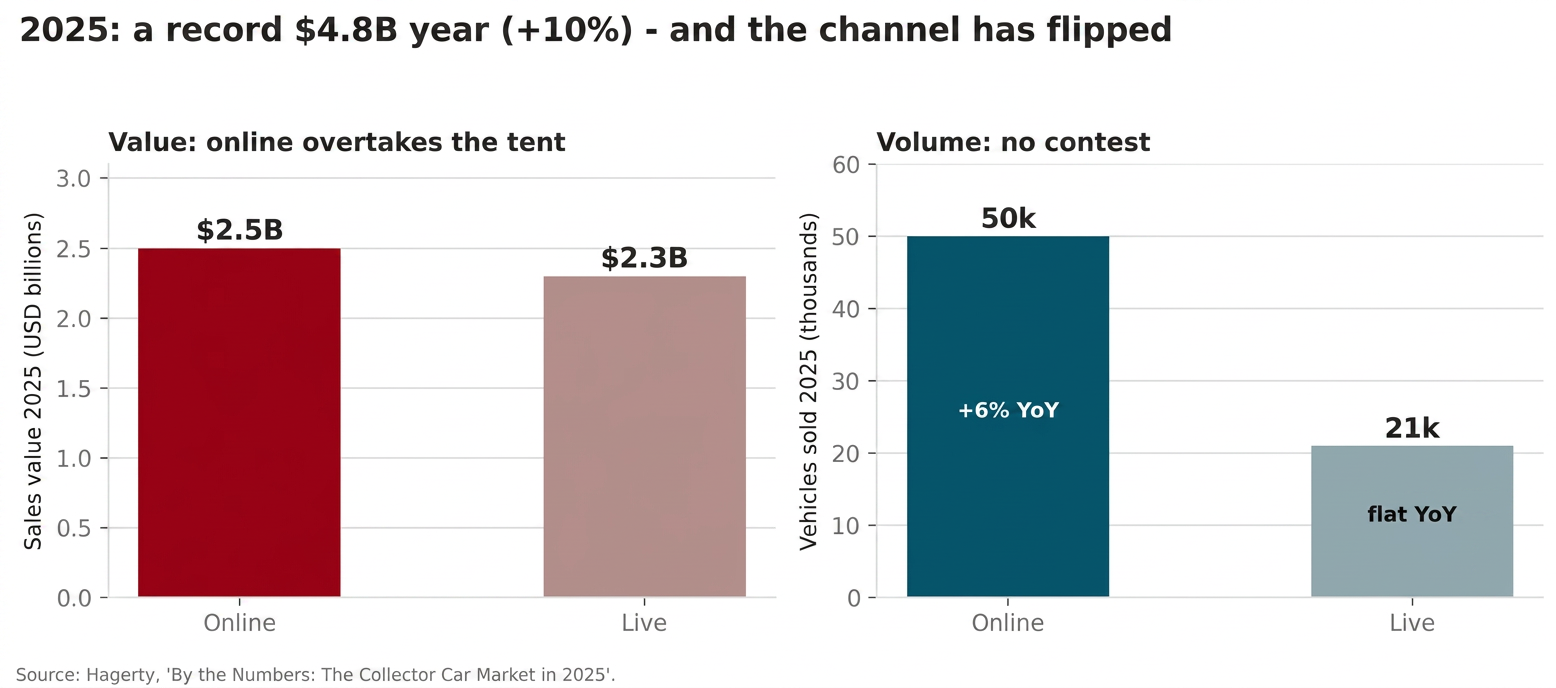
Story one: the market has never been bigger. In 2025, live auctions and online sales combined for $4.8 billion, up 10% year on year and an all-time record. For the first time, the ten most expensive sales of the year cleared $1 billion between them, at a record average of $3 million. And the online channel has officially overtaken the physical one: $2.5 billion against $2.3 billion, with more than 50,000 vehicles sold online (+6%) versus roughly 21,000 at live sales, which stayed flat.
Story two: average values have been stuck for three years. The Hagerty Market Rating, which takes the market’s overall temperature, entered 2026 at 58.28 — its lowest reading in nearly fifteen years, having fallen in 37 of the 43 months since the summer 2022 peak. In the Knight Frank basket, collector cars managed just +1.2% in the latest annual figure, while the overall collectibles index closed 2025 at -0.4%, following -3.3% in 2023 and -2.7% in 2024.
How do these reconcile? Simply: volumes and the top end are growing, average prices are not. More cars change hands, and exceptional pieces keep setting records, but the ordinary classic — the €30,000-80,000 car — no longer appreciates automatically.
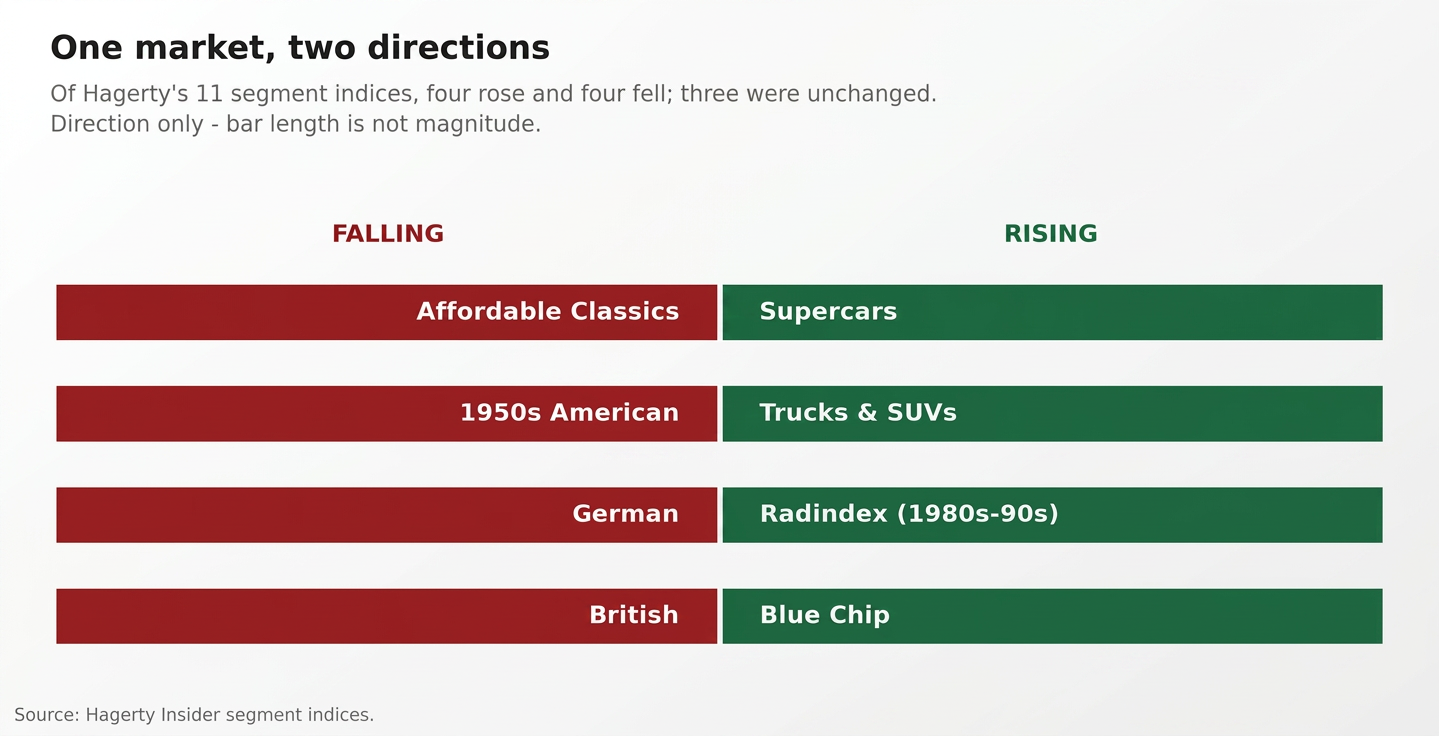
The most telling detail comes from Hagerty’s eleven segment indices: in the latest reading four rose (Blue Chip, Radindex, trucks and supercars) and four fell (British, German, 1950s American, and the “Affordable” segment). A 1965-66 Mustang GT — for decades the entry ticket to collecting — lost around 12%.
This isn’t a market in crisis. It’s a market that has become selective.
The real engine: The Buyer is changing
Behind the numbers sits a demographic shift that is both mundane and unstoppable. Baby boomers, who built this market around 1950s and ’60s sports cars, are exiting: selling, downsizing collections, giving up driving. Gen X and millennials are taking their place, and they want something else.
They want the Porsche 993, the last air-cooled 911. The BMW E46 M3. The Ferrari 360 Modena, strictly with a manual gearbox. They want the car from the poster on their bedroom wall in 1997, not the one in their grandfather’s garage. In the United States the “25-year rule” amplifies the effect: every January a fresh model year of Japanese and European cars becomes importable, and 2026 opens the door to 2001 models.
The criteria for value have shifted too. Original, documented, usable cars are winning. Over-restoration and purely speculative buying are losing ground. A car with a verifiable history and honest mileage now beats a nut-and-bolt restoration with no paperwork.
2026-2036: Five scenarios
1. The gap will keep widening. Iconic and rare cars will go on setting records — forecasts for 2026 point to more than 70 online sales above $1 million. Mid-range classics without a distinctive story will increasingly behave like usable objects rather than investments. Expecting automatic appreciation in that bracket will be a mistake.
2. The 1990s and 2000s “youngtimers” will lead. This segment has the strongest demographic pull and the tightest supply — many of those cars were driven until they were scrapped. Over the coming decade, early-2000s models will move firmly onto the radar.
3. Price transparency will compress margins. With hundreds of thousands of auction results public and searchable, the information advantage that dealers and brokers once held keeps thinning. Good news for buyers, less so for anyone hoping to profit from someone else’s ignorance.
4. Regulation is the risk worth watching. The spread of low-emission zones across European cities reduces everyday usability, and a car you can’t drive is worth less. There is a counterweight: synthetic fuels are exempt from the EU’s 2035 ban, and most jurisdictions carve out exceptions for vehicles with recognised historic status. The outcome depends on how individual countries write those exemptions.
5. Electrification will raise the emotional premium on analogue. As the new-car fleet turns electric and digital, the experience of a combustion engine with a manual gearbox becomes a sensory rarity. It’s hard to quantify, but collecting has always rewarded exactly what the world stops making.
The Bottom Line
Twenty years ago, classic cars were a passion that happened to pay. Today they are a mature market worth nearly $5 billion a year — transparent, global and, precisely for those reasons, far less generous to anyone arriving in search of easy money.
The honest projection for the next decade is moderate and highly uneven growth, driven by the generational handover rather than by financial speculation. The right cars will keep climbing. The rest will remain, simply, beautiful cars to drive.
Which, when you think about it, was the point all along.
Sources: Hagerty Media and the Hagerty Market Rating; Historic Automobile Group International (HAGI indices); Knight Frank Luxury Investment Index / The Wealth Report; CNBC; Forbes. Data current as of August 2026.
 Classic Virus