
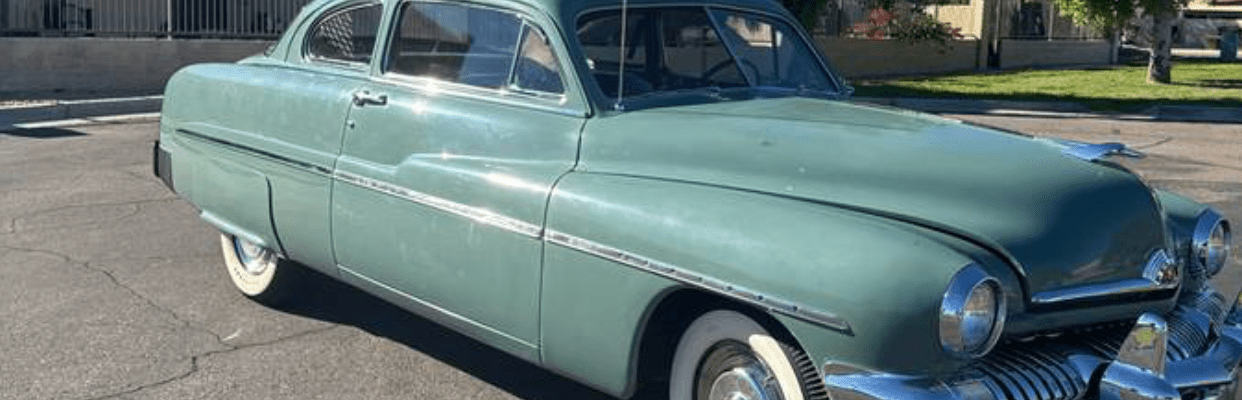
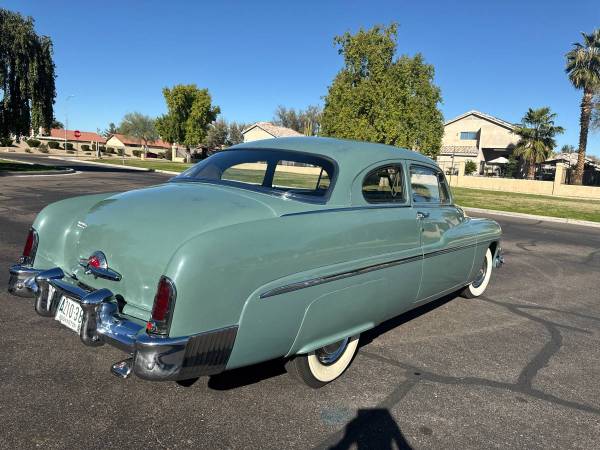
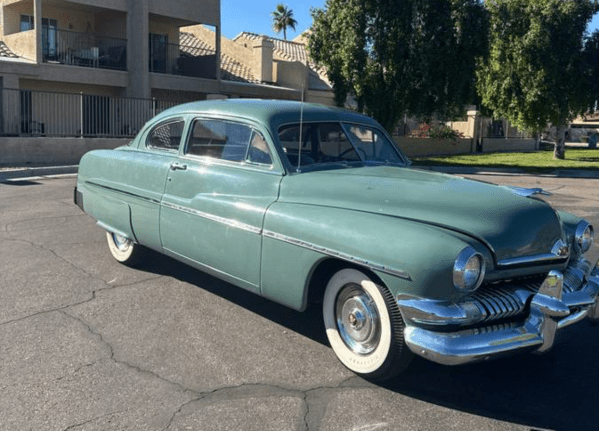
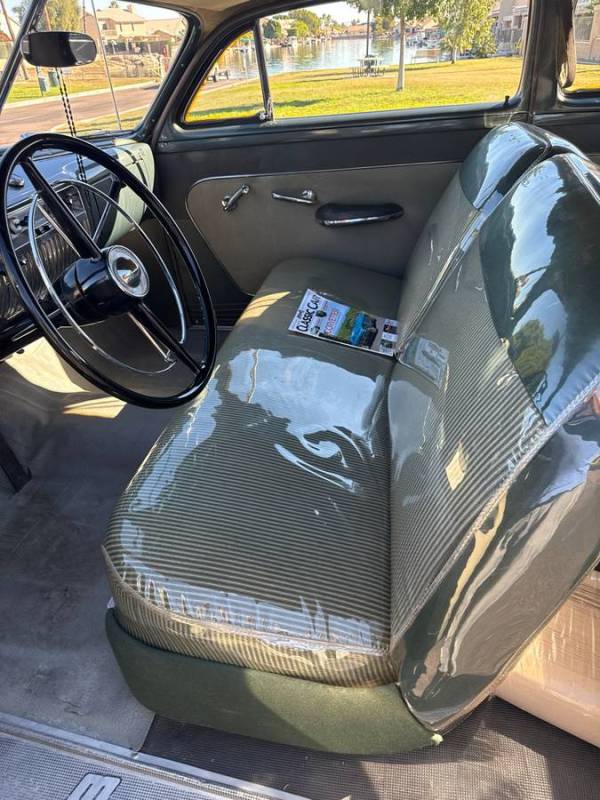
This 1951 Mercury two-door is the kind of car you usually see in period photos rather than in real life today: 26,000 miles claimed, original Coventry Green paint, and an interior that doesn’t appear to have ever needed to “play the part” of a restored car. The listing also mentions “Fingerhut” plastic seat covers: this is not a factory Mercury feature, but a typical American mail-order aftermarket accessory from the era, installed to protect the upholstery and often found only on lightly used cars.
What matters here is not just the model, but its historical context. Early-1950s Mercury sat in Ford’s lineup between Ford and Lincoln: larger and more upscale than a Ford, less formal than a Lincoln. By 1951 the styling language is pure postwar America—full volumes, skirted rear wheel openings, plenty of chrome, and a body designed for comfortable cruising on the growing highway network. It is also a moment of mechanical transition, with the flathead V8 in its final years before overhead-valve engines took over. In that sense, a 255 flathead with a three-speed column-shift is almost a snapshot of the period.
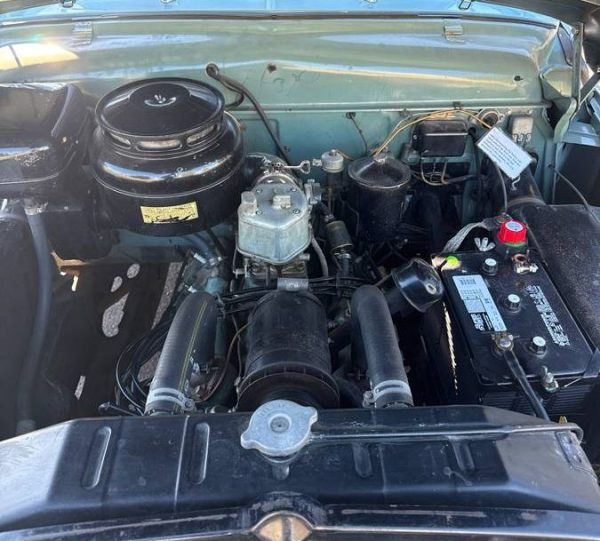
Then there is the cultural layer, which matters more on these cars than on many others. The 1949–1951 Mercury became one of the most iconic foundations of American custom culture: the classic chop-top candidate, lowered, shaved, and turned into a lead sled. For that reason, finding one described as unmodified, unrestored, and rust-free—with factory paint and interior details still readable—is uncommon. A car like this is valuable primarily as a reference point: it shows what a 1951 Mercury actually looked and felt like before it became raw material for customization. As always, the key is to verify details and documentation, but the core idea stands: if the claims are accurate, this is the kind of survivor you don’t buy to “turn it into something,” but because it has made it this far without being rewritten. Find it for sale at $39,500 here in Peoria, AZ.
 Classic Virus